Symfony Advanced Concepts
Symfony Kernel Events Lifecycle
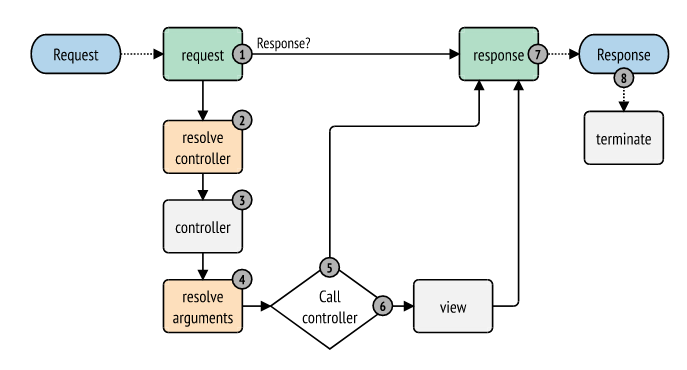
The HttpKernel component dispatches several events during a request-response lifecycle:
kernel.request: Before any controller execution.kernel.controller: After the controller has been found but before execution.kernel.controller_arguments: Before calling the controller (modifying arguments).kernel.view: If the controller does not return aResponse(converting to one).kernel.response: After the controller returns aResponse(final modifications).kernel.finish_request: After the response is sent.kernel.terminate: For long-running post-response tasks (e.g., sending emails).kernel.exception: If an exception is thrown.
Service Container Features
Autowiring & Autoconfigure
- Autowiring: Automatically injects dependencies based on type-hints.
- Autoconfigure: Automatically registers services for specific tags based on their class/interface (e.g., automatically tagging a command as
console.command). - Multiple Instances: To inject two different instances of the same class, use Named Autowiring (via parameter names matching service IDs) or the
#[Target]attribute in PHP 8.
CompilerPass
A CompilerPass allows you to manipulate service definitions before the container is compiled. This is used to collect all services with a specific tag and inject them into a "registry" or "manager" service (e.g., adding all registered transport types to a TransportFactory).
Symfony Flex
Flex is a Composer plugin that automates the installation and configuration of Symfony bundles via "recipes." It manages directory structures, configuration files, and environment variables.
Symfony Messenger
The Messenger component provides a way to send and receive messages using different transports (Redis, RabbitMQ, Doctrine, or Sync).
- Sync vs Async: By default, handlers run synchronously. To run them asynchronously, you must configure a transport and run a worker (
bin/console messenger:consume). - Middleware: Messenger uses a bus system where messages pass through multiple middleware (e.g.,
SendMessageMiddleware,HandleMessageMiddleware,ValidationMiddleware).
Form Validation
- Validation: Performed using the
Validatorcomponent, often via attributes (PHP 8) on entity properties. - Form Component: Maps request data to objects, handles validation, and manages CSRF protection.
Cyclic References
To avoid cyclic references during serialization (e.g., User -> Order -> User):
- Serialization Groups: Only serialize specific fields.
- DTOs: Use separate Data Transfer Objects for serialization.
- Max Depth: Use the
#[MaxDepth]attribute and theAbstractObjectNormalizer::ENABLE_MAX_DEPTHcontext.